
Witnessing Food Sovereignty Firsthand in Bolivia
*Alexandra was a participant on the 2013 Bolivia Food Sovereignty Tour
I spent Spring Break in Bolivia. It all started when I was doing research for a term paper on Vía Campesina and social movements’ role in civic education. I came across the Food First website and their Food Sovereignty Tours. The dates for the Bolivia trip, titled “Llamas, Quinoa and Food Sovereignty,” happened to fall right over Spring Break. But, I thought, it was too expensive to even consider, so I put the idea away and just signed up for the list serve.
A few months and four grant applications later, I was flying to La Paz. I spent the week with a group of twelve people, all of who had gathered to explore this idea of Food Sovereignty and what it looked like in the Bolivian Altiplano.
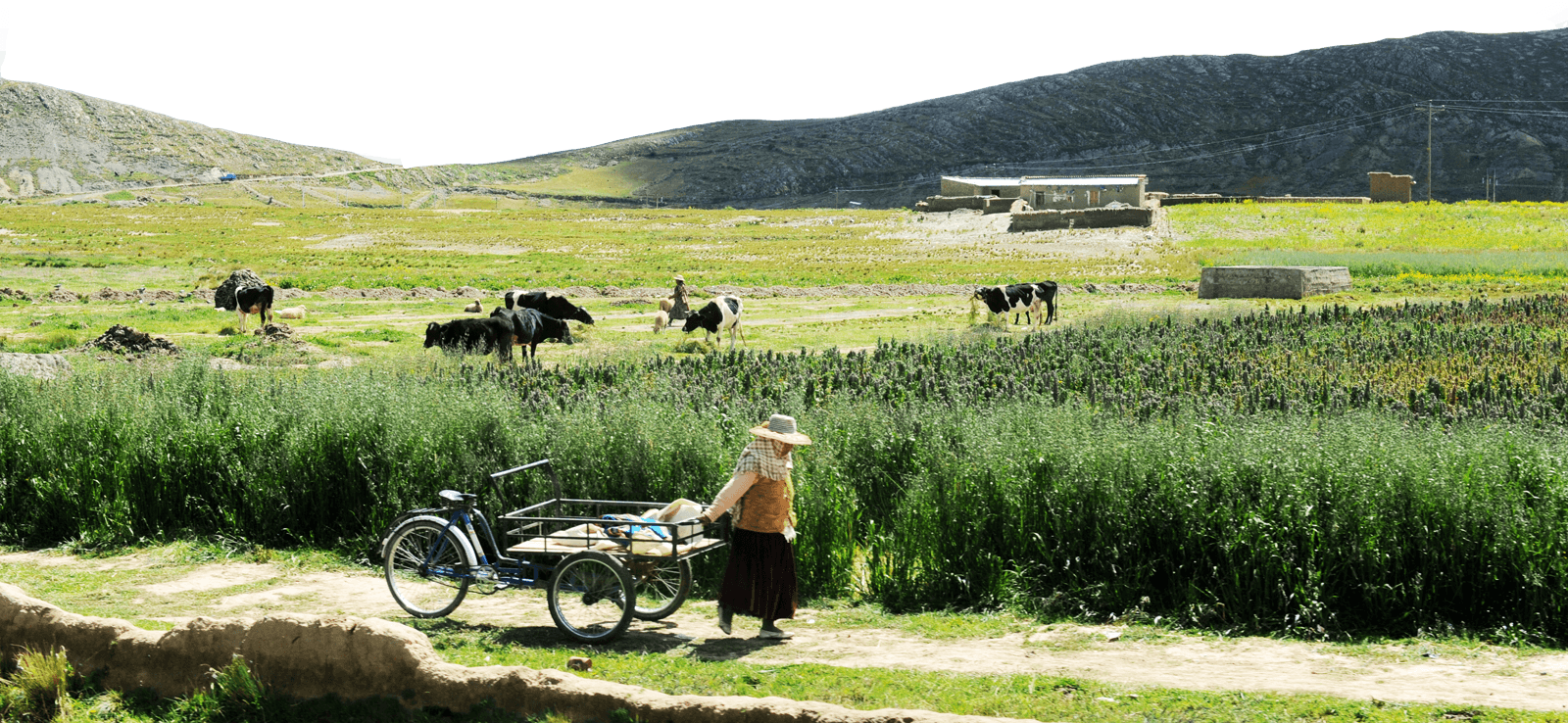
This is what it looked like to me: an open street market in the high city of El Alto where Aymara women sit? with their tarps full of potatoes or tables full of fruits, fields of quinoa in yellows, reds, purples, and greens mixed with lavender-colored tarwi, or lupus, and richly green haba plants, or fava bean, along the shores of Lake Titicaca in the shadow of the Sleeping Dragon mountain, and a valley of Royal Quinoa, proudly organically certified and exported for US consumption, grown by farmers in the community who know the names of hundreds of varieties of quinoa and can hold their heads high for the agroecological methods they are using to preserve the Gold of the Andes.
And I didn’t just see it. I tasted it. The communities we visited were eager to share with us their native products, and we were more than eager to taste everything they prepared for us. I ate all kinds of potatoes, quinoa prepared at least a dozen ways, and even a llama steak.
But more than anything, this trip reminded me why I am committed to grassroots social change: because I want to be part of building this beautiful vision of the future where all people are treated with dignity and respect.
The timing of this trip could not have been better. It is, after all, the International Year of Quinoa, presided by Special Ambassador to the Food and Agriculture Organization of the UN, Bolivian President Evo Morales. Bolivia and its controversial quinoa have been in the news quite a bit over the recent months. Some authors have argued that the recent boom in quinoa demand (and therefore production) is damaging agroecological methods and leading to overproduction. Others argue that the rise in quinoa prices benefits poor farmers who are now able to live off of their production and haven’t been subsumed by the agroindustrial complex. Consumers of imported quinoa are starting to get nervous about the ethical implications of this “super grain”.
 There are no easy answers. What I could see, beyond the rhetoric of right and wrong, are the global political and economic forces at work even in the fields of the tiny quinoa grain. Global market supply-demand mechanisms, certification procedures, visions of development, complex policy arrangements, and political posturing are sown into every plot. No farmer, no matter how small the scale, is isolated from these phenomena. What is telling however, is the farmers’ response, which in Bolivia as in many other places, is Food Sovereignty: communities coming together to empower, to negotiate change, and to represent their own interests in political and economic forums.
Stay in the loop with Food First!
Get our independent analysis, research, and other publications you care about to your inbox for free!
Sign up today!My spring break trip was an amazing experience to see first-hand this powerful global social movement called Food Sovereignty, which I will continue to study in Peru for my Masters research project. But more than anything, this trip reminded me why I am committed to grassroots social change: because I want to be part of building this beautiful vision of the future where all people are treated with dignity and respect.
*Alexandra Toledo is a CLACS and SPEA Dual MA Student at Indiana University.
 Help Food First to continue growing an informed, transformative, and flourishing food movement.