Advocacy and Agriculture in Italy: A conversation with Giorgio Cingolani
In October 2013, Giorgio Cingolani coordinated our delegation to explore food sovereignty in the Piedmont region of Italy. We were lucky to have him as our partner on this trip, as Giorgio has spent much his professional life focused on international cooperation and solidarity; supporting rural communities; and promoting awareness among urban consumers about the need for radical change in the food system. Former Food Sovereignty Tours Program Coordinator Katie Brimm recently connected with Giorgio to learn more about his background, food sovereignty in Piedmont, and what it’s like to be a small organic farmer in Italy today.
Katie Brimm: In addition to leading the upcoming Food Sovereignty Tour, you work as a small farmer and food activist in Italy. How did you get involved in this work?
 Giorgio Cingolani: Growing up among peasant children in a period when the modernization of agriculture was still to come, I had the opportunity to observe and appreciate the value of practical, hands-on knowledge. This led me to obtain a BA in Agronomy and doctoral degree in Agricultural Economics in Berkeley, California. Afterwards, I worked in applied economic research, workers union organizing, and international work with rural populations.
In the 1980’s I started to do advocacy work addressing the right to food and ecological issues in Turin [Italy] as a member of Movimento Nonviolento (MN), an Italian association that promotes nonviolence. Along with this work, I still consider my work with unions and my direct involvement with peasants essential to my personal political development.
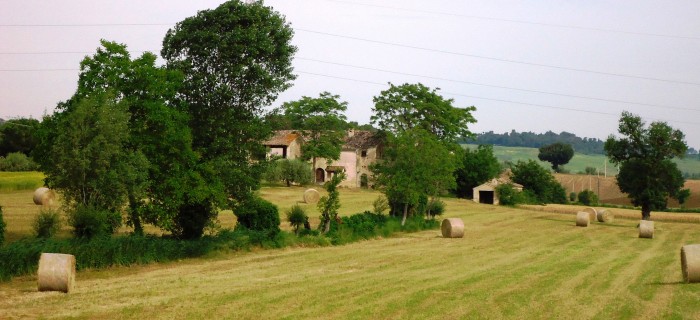
In 2000 I inherited 9 hectares [approx. 22 acres] of land from my father that I decided to convert into an organic farm. On my farm I grow farro-emmer (Triticum dicoccum), a very old wheat variety; a special variety of barley, the toasted grains of which are used to make a substitute of coffee; lentils; chickpeas; and Alfalfa. I also have established a live fence all around the farm and planted 90 olive trees.
Farming has both been an exciting next step in my life as well as a great opportunity to improve my food advocacy work- -it has given me the opportunity to expand my network and relationships with people involved in the direct production and consumption of food.
KB: As a producer, what are some of the challenges you face and how you and your community are working for change?
Stay in the loop with Food First!
Get our independent analysis, research, and other publications you care about to your inbox for free!
Sign up today!GC: The major challenge so far as a producer is the marketing of our products. Organic producers are still a minority here, although the numbers of producers and organically farmed areas are increasing. However, organic farmers usually have quite small, unconsolidated farmland dispersed over the region, which increases the distance of production to consumption. There are also difficulties that arise from an overly individualistic approach to farming, preventing essential cooperative undertakings among the organic farmers, which hinders effective political action in the local and national political arena.
Nonetheless I have managed, like other organic producers, to practice direct sales to organized groups of consumers. This helps in reducing costs and gives the opportunity to reach a broader audience and involve them in food rights advocacy work. I’ve noticed an increasing interest from consumers, especially young couples, for improving the quality of their children’s diet, as well as awareness about the dangers of industrial agriculture and decreasing the distance from production to consumption.
KB: So would you say that farming is also becoming popular among young Italians today?
GC: While there has been an increased interest among young people for healthy food and ecologically and socially sustainable practices in food production and distribution, there are too many obstacles for young people to enter into farming. Major difficulties stem from both access to land and to capital.
The current high level of unemployment among young people is creating a new interest in activities related to the production and distribution of food, but urban-biased economic policies make it difficult for them to enter into farming.
The major lesson I have learned is to increase awareness among urban consumers, which is best achieved if advocacy work is associated with concrete actions.
KB: It seems some of the challenges faced by the Italian food sovereignty movement may be parallel to what we’re seeing in the US. Do you see what is happening within social movements in Italy as a reflection of broader conditions in the global food movement?
GC: The Italian food sovereignty movement reflects both the broader conditions in the global food movement and the history of class struggle in Italy.
The Italian food system was shaped by two ideologies: the capitalist-orientated Christian Democratic Party and the socialist and communist opposition, both of which pushed for the modernization of the food system. The modern Italian conventional food system was shaped after WWII: the production, processing and consumption of food became oriented towards increased efficiency.
The need for industrialized innovations such as labor savings techniques (both in agriculture and in domestic food processing) was virtually undisputed. Powerful processing industries were decisive actors for shaping food practices from farm to fork. Food policies, both in the production and distribution aspects, were biased in favor of capital and urban areas, against peasant labor interests.
However this framework of values, policies and practices in the food system over the years has recently been disputed because of its unsustainability. The growing influence of safety incidents, food crises, public protests against genetically modified food and debates over the globalization of food production and consumption have introduced the need for changing the rules of the game. The public has pressured the European Union and national governments for agricultural policies that promote more sustainable food regimes.
The Italian Food sovereignty movement really emerged from these pressures and contradictions.
KB: What have been some of the biggest lessons you’ve learned about effective strategies of resistance and social change?
GC: The major lesson I have learned is to increase awareness among urban consumers, which is best achieved if advocacy work is associated with concrete actions. That means that people need to be shown concrete, albeit small, innovative activities to be convinced and directly involved in a struggle for social change. Organizing activities for consumers to directly engage in food production; providing capital for investment in farming [as in consumer-supported agriculture, or CSAs]; or facilitating consumers’ participation in farm work, volunteer work in farmers’ markets and organized farm tours are some effective ways to educate and engage consumers in social change.
Most effective actions for social change need good organizing with detailed strategies and realistic, achievable goals that can be accomplished with the resources available. Finally, effective social change needs time. There is a need for perseverance and a global vision while engaged in local struggles.
KB: What do you hope participants will take away from their experience on a Food Sovereignty Tour?
GC: I hope and wish that participants on our Italian Food Sovereignty Tour will return to their home having spent a useful and happy time both together and with all the good people that we will introduce to them.
There is no better way to learn about food democracy than to meet with the very people carrying on the struggle by investing their time and intelligence to produce and distribute good, clean and fair food.
*Katie Brimm is the former Program Coordinator for Food Sovereignty Tours
--> // // Removidas / comentadas de forma segura. Se precisarem no futuro, reimplementar sem misturar HTML comment com PHP. ?> Help Food First to continue growing an informed, transformative, and flourishing food movement.