“Baserrias” Preserve Basque Culture through Agrotourism
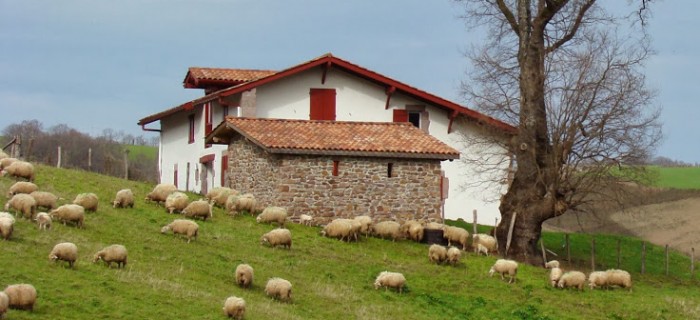
On a warm evening in late May 2011, a group of 16 people—educators, farmers and activists—sit around a large table overlooking a deep green valley in the Basque Country. Cattle and sheep graze in a nearby field and our table is lined with glasses half-full of regional tempranillo wine, cheeses, jams and jellies. Maite—our host, cook, matriarch and ex-secretary general of the Basque Farmer’s Union (EHNE)— comes out to ensure that we are enjoying our appetizers. One participant of our Food Sovereignty Tours delegation asks about a certain cheese that we have been sampling throughout our stay. Maite exclaims “es muy facil hacer!” (It is very easy to make!) and asks if we would like to learn how to make it. Just after sunrise the next morning, early risers from the group join Maite’s impromptu cheese-making workshop in the kitchen, using sheep’s milk from her own herd.
In this simple exchange of culture, food and farming tradition, Maite shared a piece of Basque food culture that was almost completely lost.
Many people are familiar with the term “ecotourism,” defined by the International Ecotourism Society as “responsible travel to natural areas that conserves the environment and improves the well-being of local people.” Far fewer people, however, are familiar with the term “agrotourism,” which focuses specifically on rural culture and livelihoods. In the Basque country, an “agroturismo” refers to a traditional Basque farmhouse, a caserio, which has been converted to serve as both a farmhouse and a kind of bed and breakfast—an initiative created to support traditional agriculture and community.
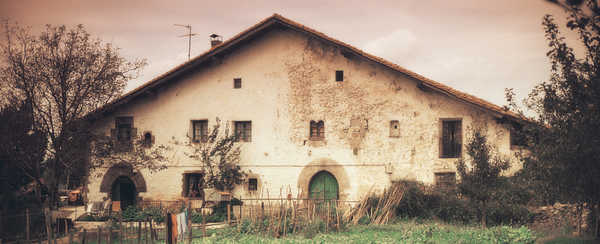 In the past, caserios were an important part of Basque culture. Some date as far back as 500 years and have been passed down for generations. Traditionally two-story self-sustaining and self-reliant units, caserios housed farm animals (the family’s most prized possessions) on the bottom story and their human residents on the second story. In addition to providing for the majority of their own needs, caserios also had specialized production. This allowed them to trade and barter with other caserios. For example, one caserio’s specialty may be cheese, another’s preserves, another’s cider and yet another’s meat. This specialization was critical in Basque country, where there is limited usable farmland and where outside connections were (and are) limited for political, social and geographical reasons. The caserios were critical in keeping the region’s inhabitants interconnected and maintaining strong and healthy communities.
Starting in the mid-1800s, and increasingly throughout the 20th century, younger generations began migrating to cities and towns, leaving their caserios and land abandoned. Caserios, lands, animals, knowledge, language and community were just some of what was lost in the process.
However, this process has begun to turn around. In 1989, the Basque government began a program that subsidized the renovation of caserios under the conditions that the land be farmed, and that it use its second function, as a bed and breakfast, to support the farm’s economic stability. This was the birth of “agroturismos” or baserrias, as they are called in Euskara, the Basque language.
Agroturism is a working experiment in farm tourism that has had a major impact on rural farm culture in the Basque Country. It has made it possible for people like Maite to live a dignified and creative life as a farmer and activist, as well as to host visitors who support a similar vision for land and resource use.
By exchanging ideas and sharing traditional recipes, our delegation formed a strong bond with Basque culture and a commitment to this amazing way of life.
Stay in the loop with Food First!
Get our independent analysis, research, and other publications you care about to your inbox for free!
Sign up today!A special thanks to our agrotourism hosts Ainhoa, Alex and Maite. Basque Food Sovereignty Tour 2011.
--> // // Removidas / comentadas de forma segura. Se precisarem no futuro, reimplementar sem misturar HTML comment com PHP. ?> Help Food First to continue growing an informed, transformative, and flourishing food movement.