Broadening the Base: EcoVillage Farm and the Food Justice Movement
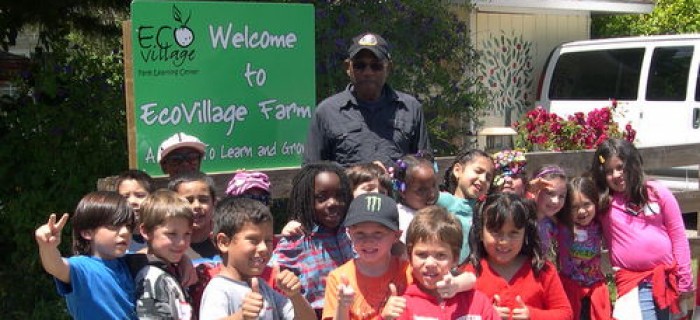
Shyaam M. Shabaka, the founder and director of EcoVillage and a Food First board member, has a wealth of knowledge about how to work collaboratively in the Bay Area. EcoVillage Farm, located in Richmond, has created many successful collaborations. EcoVillage Farm is a place where people with a wide range of skills and interests can get involved in food justice and community work. They work with a great variety of people, and attempt to broaden the base of the food justice movement as a means to strengthen the movement.
During the 1990s, at the height of the cocaine and crack epidemic, Shyaam started many community gardens as an alternative form of youth engagement. These experiences taught him that gardens can serve to deter at-risk behavior and ultimately incarceration. When Shyaam retired from the Berkeley Public Health Department, he decided to dedicate his life to youth and community development in low-income communities.
EcoVillage was founded on these principles. Its mission is to grow healthy youth and healthy communities. Shyaam says of the EcoVillage model: “People are an important part of the environment and we want to broaden the range of people involved in environmental and social justice work to include urban residents and people of various cultural backgrounds.”
Richmond is ground zero for EcoVillage, but they work throughout the Bay Area. The primary focus of the farm’s activities is with youth, student groups, and people of color. While EcoVillage is a farm, urban agriculture is not its most important goal. They instead focus on creating opportunities for youth, and educate young people on what they can do to overcome the institutional barriers that they face.
EcoVillage has engaged in a wide spectrum of projects, including working with youth in the West Contra Costa Unified School District who are not in school and therapeutic programs for students with disabilities from De Anza High to help them develop job skills. They also run a CSA and farmers’ market plus public education about the links between unhealthy foods and diet-related preventable disease. Another area they tackle is participatory action research on mercury-poisoning caused by eating Blue-Heel fish. “You don’t have to have a Ph.D. to get involved in meaningful research,” Shyaam says. This gives youth the opportunity to build on existing community knowledge.
Collaboration with other groups in Richmond is also central to the farm’s activities. They promote healthy living and eating with faith-based organizations, work with corner stores to provide fresh produce, and partner with the regional office of the Social Security administration to promote employee health. Shyaam also as serves on the Richmond Food Policy Council.
The importance of the EcoVillage project in Richmond is situated in a particular historical, political, and economic context, which is largely the product of abuse by industry. During the 1940s, as part of wartime production, many industrial companies, including Chevron and the ship builder, Kaiser Industries built war ships in Richmond. Discriminatory housing policies in San Francisco and Oakland, forced many African-American migrants, who came for jobs, to live in Richmond. After the war, unemployment and underemployment and heavy contamination combined to create the current conditions of precarious public health. Shyaam chose Richmond because it is a community with great environmental justice challenges.
Stay in the loop with Food First!
Get our independent analysis, research, and other publications you care about to your inbox for free!
Sign up today!EcoVillage is in the process of developing a twelve-week internship program. However, the internship program as a whole is fluid, and Shyaam works with interested individuals to match work to their interests. While he has worked with college students before, he is looking for people who think critically about their engagement, not someone looking to write their research paper and move on. “The best intern I ever had,” Shyaam said, “was a guy who was taken to the morgue twice when presumed dead.” Despite alcoholism, the man was able to turn his life around. “He learned a lot, but also taught me and a lot of people.”
When I asked Shyaam how people outside Richmond can get involved with or support EcoVillage, he replied: “the same as people in Richmond.” Time and interest are the key ingredients. It is up to the individual what kind of experience they want to have. You can work with people of all ages, or learn about beekeeping from a professional, among many other agricultural crafts. “We don’t have one shoe that fits all,” says Shyaam. “Do you want to walk? Do you want to dance? We match the character of interested people’s engagement to their interests and what they want to get out of it.”
While Food First has always billed itself as a think-and-do people’s think tank, Shyaam as a member of the Food First board, worked to bring the doing in balance with the thinking. According to Shyaam, “In this movement, we don’t have the luxury of sitting back and just commenting.” EcoVillage works on these principles. When asked about how the food justice movement can move forward, Shyaam replied that the base of participants needs to be broadened. Food justice is still a largely white middle class enterprise. Success will depend on the movement becoming more integrated into our diverse cultures. Shyaam believes we must frame the argument according to context. For some, food justice is principally about social and environmental justice. For others, it could be framed in economic terms. Different incentives will draw different people. “If you have ten jobs, 1000 people will show up to apply. How do we create the will to create those jobs?” Shyaam believes this contextual framing is what challenges food justice, but also provides a means to build a broader movement.
Learn more about EcoVillage and how to get involved.
--> // // Removidas / comentadas de forma segura. Se precisarem no futuro, reimplementar sem misturar HTML comment com PHP. ?> Help Food First to continue growing an informed, transformative, and flourishing food movement.