
Food Sovereignty and Pachakuti: An eco-justice perspective on the food system
by Alexandra Buck Toledo, Food Sovereignty Tour participant, Bolivia 2013
I am in a farming community on the shores of Lake Titicaca. The table is set and the steam from the hot food rises into the heavens. We take a moment to thank all those people who contributed their effort, sweat, work, and care to prepare this food that we are about to eat. A sacred moment.
I can feel the quality of the food and the intense flavor that was transferred through its connection to the earth. How delicious it is to eat fresh food, with no processing! A boiled potato, recently taken from the earth, peeling back its skin and seeing underneath the variety of colors, gifted from the Pachamama—Mother Earth. And even better than that: the farmers themselves are proud of their harvest and the possibility to share it with us. Absolutely sacred moments.
All of this took place in March when I traveled to Bolivia with a Food Sovereignty delegation coordinated by the U.S. organization Food First. It formed part of my research of looking at world food systems from a political, economic, social and—for the first time here—spiritual perspective. I begin this reflection with a geographic image of the global food system and continue with an introduction—both political and spiritual – to the concept of food sovereignty, concluding with an examination of the connection between food sovereignty and eco-justice.
The signs of the times: plants and plates
What I see in the current world food system is a tension between two ways of eating: the industrial style and the agroecological method. The first example is certainly more “typical” in the United States: supermarkets, processed foods in bags and cans, and fast food. This style of eating is based on the market system where every product is always available—fruit in the frozen winter imported from the South. What the customer wants, there it is, without bruises, without dirt and without . . . flavor.
This model is what Philip McMichael (2005) calls the “corporate food regime,” characterized by agribusiness, industrialized agriculture, supermarkets and the commercialization of food. The current regime also includes within itself the contradictions of the project in development: “[T]he corporate food regime embodies the tensions between a trajectory of ‘world agriculture’ and cultural survival, expressed in the politics of ‘food sovereignty’” (p. 278) and based in the practice of agroecology.
Stay in the loop with Food First!
Get our independent analysis, research, and other publications you care about to your inbox for free!
Sign up today!Here, then, we have the alternative option. Agroecology does not simply mean “organic” because organic can also be industrialized and commercialized. This alternative option is based in the movement for community gardens, access to farmers’ market, and the revaluing of local, fresh food.
Both models respond to the global problems of hunger, malnutrition and food insecurity. In the first model, the idea is that hunger is resolved through greater availability of products with international commerce (facilitated by Free Trade Agreements) and industrialized production, pushed by agribusiness multinationals. And yes, these advances help provide food products on a global level. There are corporate interests, however, that profit from taking advantage of the neoliberal model and agricultural mechanization without concern for nutritional quality or environmental impact.
Another path towards food security is through food sovereignty, a very different proposal from that of the neoliberal model of food.
What is food sovereignty?
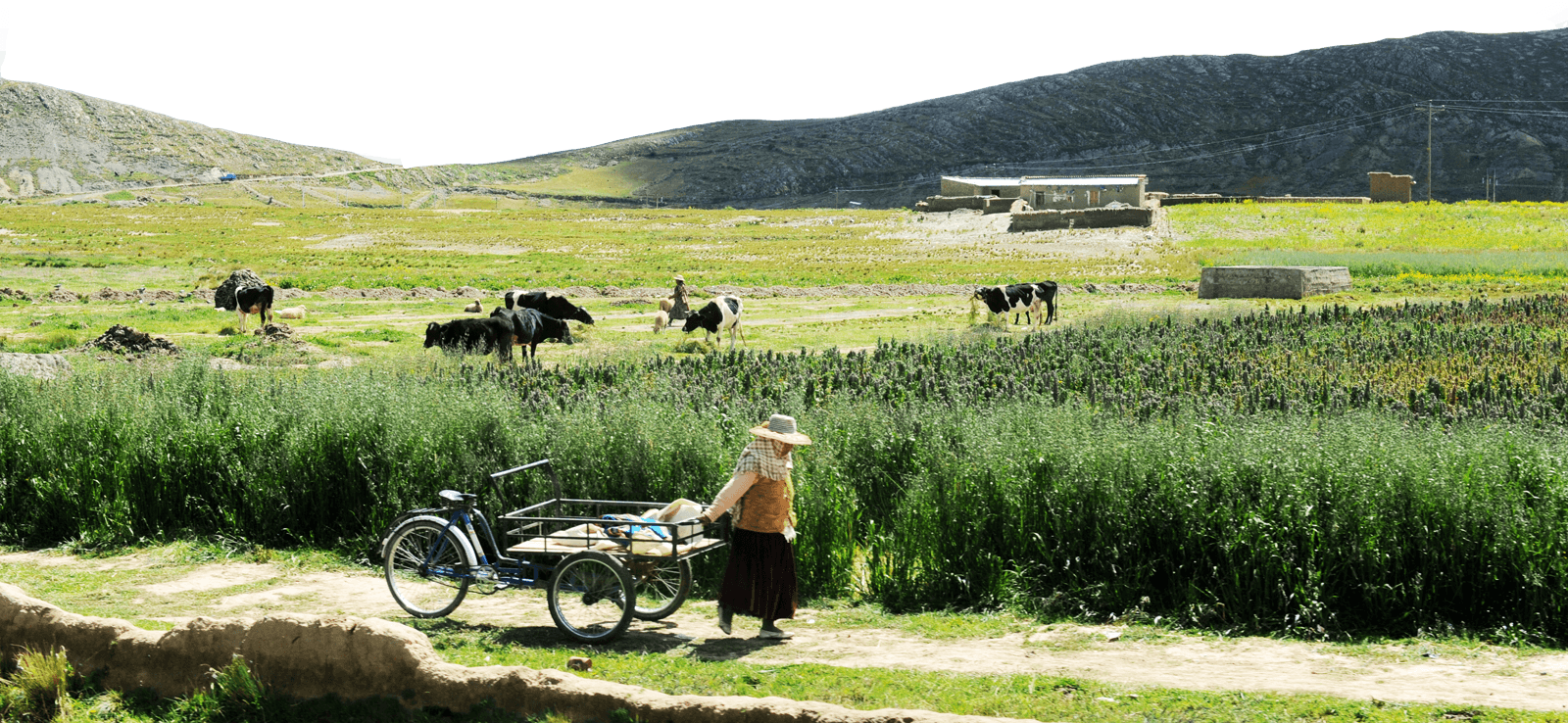
I traveled to the shores of Lake Titicaca, the southern highlands and the salt flats of Bolivia to learn about the way of life there and the production of quinoa. In each place, I asked myself: Is this food sovereignty? In Lake Titicaca, where people live from their harvest, but the younger generations have mostly gone to search work in other places? Or, in Rodeo, the model community with organic certification to get a better price to export their royal quinoa variety? Possibly the salt flats, where the quinoa and the alpacas live in interdependence…but where the villages are abandoned and families only come to harvest?
Is that food sovereignty? Well, yes . . . and no. It is not so simple to find “food sovereignty” as a way of life. I think that I saw, felt, ate and shared pieces of food sovereignty in the complexity of poverty, lack of rural infrastructure and political battles.
The families of this community have cared for these seeds and for these foods for generations, and so we are not just thanking the friends who planted, cultivated and harvested what is on the table, but also generations before and generations after.
Food sovereignty is a political proposal from civil society as an alternative way of organizing the world food system. It emerged in 1996 in reaction to the World Food Summit about food security organized by the United Nations Food and Agricultural Organization (FAO). Vía Campesina, the international peasant movement, was excluded from this meeting. Displeased and unsatisfied with the official definition of food security and its use to consolidate projects of free trade and multinational investment in agriculture, Vía Campesina developed the framework of food sovereignty. They define food sovereignty in their declaration Food Sovereignty: A Future without Hunger in this way: “Food sovereignty is the right of each nation to maintain and develop its own capacity to produce its basic foods respecting cultural and productive diversity. We have the right to produce our own food in our own territory. Food sovereignty is a precondition to genuine food security” (Vía Campesina 1996).
From that point, the platform of food sovereignty has been used by various groups in various ways, so there is no single definition or manifestation of food sovereignty.
What could food sovereignty be?
From my perspective, food sovereignty is a visionary proposal of a different future. Within this framework, then, instead of asking ourselves what it is, we can ask what it could be. If we see it from this perspective, we are recognizing the possibility for a time of transformation that in Bolivia is called Pachakuti or “change of the earth.” This seems to me an appropriate vision if we analyze transformation from the level of the earth and its fruits.
Food sovereignty could be right relations between the earth and the farmers, the peasants and the markets, the sellers and the buyers. It could be fair policies developed democratically and in the best interest of the people. It could be healthy, sufficient food for all people so that they grow to their maximum potential in this world, leaving behind poverty, hunger, and illness. It could be Pachakuti.
However, food sovereignty scares the market and state forces. For them, food sovereignty could be an autocratic threat to their way of organizing food systems. It could be a loss to their gains, their political power, and their control of decisions. It could risk international agreements and undermine the national economy at an international level. Yet at the same time, it could be an opportunity to integrate the voices of the social movements into the policies of the state and thereby dissuade them from protest.
How could food sovereignty be a manifestation of eco-justice?
Food sovereignty is about the construction of a better world, made of faith, love and right relations respecting Mother Earth, or Pachamama. It is expressly spiritual and simultaneously absolutely commonplace regarding the rituals practiced for the planting and the harvest in many Andean farming communities. Integrating this respect into world agriculture would mean a “change of the earth,” a transformation of the organization of the world food regime. It would be eco-just agriculture.
There are seven elements to the food sovereignty platform that we can connect with the construction of eco-justice: food as a basic human right; agrarian reform; protecting natural resources; reorganizing the food trade; ending the globalization of hunger; social peace; and democratic control (Vía Campesina 1996).
I think that the challenge for each one of us that plants, cultivates, harvests or—at the very least—eats, is to try to do so in the most just way, to contribute to food security and sovereignty. Each one of us can construct a more just food system, starting with our own plants and plates.
I look at the table in that community on Lake Titicaca in Bolivia, and I see so many varieties of native foods: potato and quinoa, corn and beans. The families of this community have cared for these seeds and for these foods for generations, and so we are not just thanking the friends who planted, cultivated and harvested what is on the table, but also generations before and generations after. For those who protected, those who protect, and those who will protect. Truly a sacred moment.
Alexandra Toledo is an MA student at Indiana University, Bloomington, pursuing a Master of Public Affairs at the School for Public and Environmental Affairs and a Master of Arts in Latin American Studies at the Center for Latin American and Caribbean Studies. Her thesis explores food security and food sovereignty policies in Peru.
--> // // Removidas / comentadas de forma segura. Se precisarem no futuro, reimplementar sem misturar HTML comment com PHP. ?> Help Food First to continue growing an informed, transformative, and flourishing food movement.