Food Waste: Valuing a New Commodity
A commodity is, in the first place an object outside us, a thing that by its properties satisfies human wants of some sort or another. The nature of such wants, whether for instance they spring from the stomach or from folly makes no difference.[1]
That’s right, under the capitalist mode of production food is a commodity, just like any other. It doesn’t matter if the food is fresh organic arugula or a Big Mac, teff from the highlands of Ethiopia or Cheez-Whiz from Wal-Mart. It doesn’t matter whether you need it or not, whether it is good or bad for you, whether it is locally produced or traveled from afar or whether it was corralled, caged, free range or led a happy life; if enough people want it (and have the money to buy it), someone will turn it into a commodity and sell it—even food waste.[2]
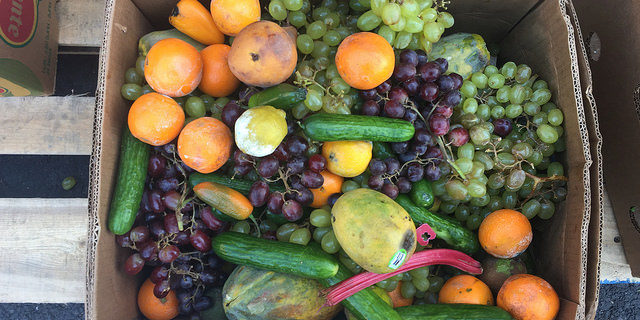
Forty percent of food grown in the United States and around the world is “wasted,” generating global concern about the social and environmental costs of food waste. On one hand, waste is food that is “lost” to the eater. But food waste is also a by-product, a factor of production that has simply been used up.
The term waste is based on the Latin vastus, meaning “unoccupied” or “uncultivated.” When we think of wasting food—our sustenance—we invoke the term as a verb, “to use or expend carelessly, extravagantly, or to no purpose… to fail to make full or good use of.” But capitalism tends to treat food waste as an adjective, “A material, substance or by-product eliminated or discarded as no longer useful or required after the completion of a process.”[3]
Food provisioning uses 10 percent of the total U.S. energy budget, 50 percent of national land, and 80 percent of all fresh water consumed. Since 40% of our food is wasted, Americans throw away the equivalent of $165 billion in resources each year.[4] Theoretically, reducing food losses by just 15 percent yearly, could save enough to feed over 25 million Americans. This is why everything from composting and energy generation, to food banks and the sale of “ugly fruit” is being thrown at the problem.
Some of these measures could help reduce some of food waste’s landfills, GHG emissions, and needless use of natural resources, and that’s a good thing. But these proposals all focus on the effects of a wasteful food system and ignore the primary cause of food waste: overproduction.
The defining characteristic of capitalism is its tendency to overproduce. The food system is no exception (we’ve been producing 1 ½ times more than enough food to feed everyone for the last half century—and still can’t end hunger…). Our cheap grain policy drives farmers to overproduce, leading to constant gluts. This is bought up cheap by agrifood and energy companies that turn it into cheap food products, feed for CAFOs and ethanol. The objective is to sell as much as possible. Similar trends occur in fruits and vegetables. Low prices, standardization and the big lots demanded by retailers drives farmers to get bigger and produce more, flooding the market. Even at our beloved—but saturated—farmers’ markets, farmers select only the most cosmetically attractive produce for display and throw out, give away, or compost the rest. These farmers work on thin margins and tend to pay high rent for farmland that is close to urban markets.[5] Food waste is a collateral effect of their market strategy for economic survival.
The value of food waste: from by-product to commodity
Waste in a capitalist food system is more than just the “cost of doing business.” It is a part of the value of the food that is actually eaten. How? Because the labor and resources that were expended to create value in the food value chain when producing food don’t magically disappear when part of the food is wasted. This overall value is still in the product and is captured in the sale of the product. We call this capture of value “profit.” If waste is brought back in to the value chain it came from (by turning it into a commodity), it doesn’t bring in “new” value. Rather, it distributes the existing value in the food chain across another product: recovered food waste. The question is, who is ultimately going to capture this value? The farmer? The consumer? The food insecure? No, it is the big retailer… they’ve bought that value to begin with and they want all of the profits that accrue from it. This is why, sooner or later, all food waste start-ups will eventually be bought out (or driven out of business) by supermarket monopolies.
Stay in the loop with Food First!
Get our independent analysis, research, and other publications you care about to your inbox for free!
Sign up today!Waste is endemic to capitalist overproduction. Turning food waste into a commodity (or donating it to food banks) does nothing to address the cause of waste, (though it might create new businesses that depend on food waste for their existence). The key to ending food waste is to end overproduction. The key to feeding people is not by commodifying ugly fruit, but by paying living wages and making good, healthy food readily accessible to everyone, not just those who can afford it.
1. Karl Marx, Capital: A Critique of Political Economy, vol. 1, 3 vols. (New York: International Publishers, 1967).
2. E Holt-Giménez, A Foodie’s Guide to Capitalism: Understanding the Political Economy of What We Eat (New York: Monthly Review Press/Food First Books, 2017).
3. “Waste,” Oxford Living Dictionary, accessed January 1, 2016, https://en.oxforddictionaries.com/definition/waste.
4. Dana Gunders, “Wasted: How America Is Losing Up to 40 Percent of Its Food From Farm to Fork to Landfill” (National Resources Defense Council, August 2012), https://www.nrdc.org/sites/default/files/wasted-food-IP.pdf.
5. Caitlyn Hachmyer, “Notes from a New Farmer: Rent-Culture, Insecurity, and the Need for Reform,” in Land Justice: Re-Imagining Land, Food and the Commons in the United States (Oakland, CA: Food First Books, In Press).
The cover image was taken by Luke Jones (CC BY 2.0).
--> // // Removidas / comentadas de forma segura. Se precisarem no futuro, reimplementar sem misturar HTML comment com PHP. ?> Help Food First to continue growing an informed, transformative, and flourishing food movement.