
On the Table – Back to Our Roots: Eating Well on a Small Planet
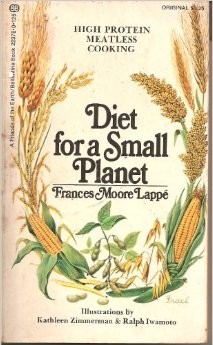
Over forty years ago, Frances Moore Lappé was just starting to ask the questions that would formulate her groundbreaking book, Diet for a Small Planet which would later catalyze the foundation of Food First as an organization. The same questions that Lappé asked in her seminal text still ground our work at Food First today. Using food as a lens, Lappé sought to show that understanding the power structure of our current food system is empowering, and that big change can begin with small changes by the individual:
To ask the biggest questions, we can start with the most personal—what do we eat? What we eat is within our control, yet the act ties us to the economic, political, and ecological order of our whole planet. Even an apparently small change—consciously choosing a diet that is good both for our bodies and for the earth—can lead to a series of choices that transform our whole lives.
To honor our beginnings in this special anniversary edition of “On the Table,” Movements (a newsletter of Food Sovereignty Tours) brings you one of the recipes from Diet for a Small Planet’s beloved back pages, “Eating Well on a Small Planet,” in which Lappé gives examples of recipes that highlight the “traditional plant-based diet” that the book promotes. Simple and delicious, these recipes were meant to empower readers to start implementing change from their own kitchens.
Changing the way we eat will not change the world, but it may begin to change us, and then we can be part of changing the world.
More than just recipes, Diet for a Small Planet was a reminder that we need not look only to “experts” to explain the world’s problems and engineer solutions, but that we the people should follow our own noses, begin with our own curiosity, and even in the face of the profound problems we find in our global food system, we have the capacity as individuals to find hope and make change. As Lappé says, “Honest hope comes only as we experience ourselves changing, and are thus able to believe that ‘the world’ can change.” She goes on to say:
 For many who have come to appreciate the profound political and economic roots of our problems, a change in diet seems like a pretty absurd way to start to change things. Such personal decisions are seen simply as a handy way to diminish guilt feelings, while leaving untouched the structural roots of our problems. Yes, I agree—such steps could be exactly this and nothing more.
But taking ever greater responsibility for our individual life choices could be one way to change us—heightening our power and deepening our insight, which is exactly what we need most if we are ever to get to the roots of our society’s problems. Changing the way we eat will not change the world, but it may begin to change us, and then we can be part of changing the world.
These sentiments are just as true now as they were in 1971, when the book was first published. Thinking back to those times, it seemed specially fitting to include this particular recipe, which due to its popularity, made it into the twentieth edition. This is the dish Lappé served during her very first meeting in Berkeley with Betty Ballatine of Ballatine Books, who was trying to persuade Lappé to publish the text that would become Diet for a Small Planet.
Stay in the loop with Food First!
Get our independent analysis, research, and other publications you care about to your inbox for free!
Sign up today!Of course we all know now that the rest, is well, our history.
Betty Ballantine and I spent the day together. I served her a Diet for a Small Planet meal—Mediterranean Lemon Soup and Middle Eastern Tacos. She loved it. I told her my concerns about who should publish the book and how I wanted it to be published. Never did she try to convince me to publish with Ballantine. As she left that evening she said, ‘Whoever publishes the book, I’ll buy it.’
Middle Eastern Tacos
From Diet for a Small Planet
Makes 10 tacos
Wonderfully tasty and satisfying! Of all the recipes that appeared in the 1971 edition, this is the one my family has eaten most often. The bean-sesame mix makes a great cracker spread, too. With precooked beans, the whole thing can be put together in no time. Increase any of the spices to taste.
 Ingredients
3 cups well-cooked garbanzo beans (1 cup uncooked)
½ cup ground toasted sesame seeds or ¼ cup sesame butter2 cloves garlic
2 tablespoons lemon juice
¾ teaspoon ground coriander
Salt to taste
½ teaspoon ground cumin
¼ to ½ teaspoon cayenne pepper
10 pieces Middle Eastern flatbread (pita) or wheat tortillas
Garnishes: shredded lettuce, chopped tomatoes, chopped cucumber, chopped onion, 1½ cups yogurt or grated cheese
Preparation
Purée together beans, sesame seeds, garlic, lemon juice, coriander, salt, cumin, and cayenne pepper, adding bean cooking liquid or water if necessary to make blending easy. Let stand at room temperature at least 30 minutes. Cut flatbread in half (to give 2 semicircles from each) and fill pockets with bean mixture. (If you like, heat filled pockets in oven before garnishing. If serving on wheat tortillas, fry until soft but not crisp.) Set out garnishes and let everyone assemble their own. Each portion should include yogurt or cheese topping to complete the protein complementarity.
Complementary protein: beans + sesame seeds + milk product + wheat
--> // // Removidas / comentadas de forma segura. Se precisarem no futuro, reimplementar sem misturar HTML comment com PHP. ?>
 Help Food First to continue growing an informed, transformative, and flourishing food movement.