On the Table—Remembrance of Things Basque
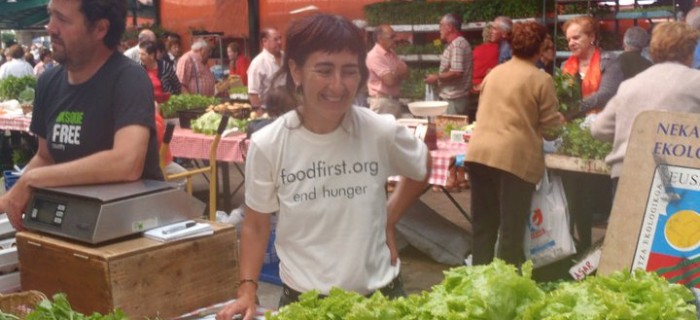
Last March, I joined a Food Sovereignty tour to the Basque Country. We began the trip with a few nights in Ajangiz, just a stone’s throw from Gernika (Guernica). Our hosts, farmer-activists Ainhoa and Alec, welcomed us into their caserio, a renovated old stone farmhouse visually similar to many that stud the verdant hills of the Basque countryside in this region. At one time livestock lived on the lower level of this massive caserio, with three generations of family members lodged above. Now, to our good fortune, Ainhoa and Alec operate an agriturismo (agricultural bed and breakfast) here. They grow vegetables and fruit, which they sell at the Gernika farmers’ market and exchange within their food co-op, while also raising two children along with a herd of sheep and various other animals.
Here, over dinner, our journey together as a group began. We feasted on several courses: a main dish of delicious sautéed heche (a local fish) was preceded by locally produced and cured ham and a vegetable soup sourced directly from the garden. We finished dinner with local cheeses and homemade membrillo (quince paste). Bottles of the regionally produced txakolina, a slightly sparkling dry white wine, stimulated our palates and our conversation throughout the meal.

Ainhoa gives the 2014 Food Sovereignty delegation a tour of her kiwi orchard, blooming just in time for Spring.
My travel notes help me to report the details of this first dinner, but my memory emphasizes one particular course above all: the thick, rustic vegetable soup that ushered in the meal. Shortly after returning home to Boston, I began to develop a craving for this soup Ainhoa had prepared from her garden, which she explained was her version of a very traditional Basque recipe.
To speak of a craving is an understatement. Reproducing this soup became a veritable obsession, and I could not turn to other matters before having this soup once more before me, in front of me, in me. Ainhoa had vaguely sketched out the ingredients and the mode of preparation, but the proportions and cooking time were a mystery.
While searching for recipes, I learned that this traditional Basque soup is interpreted in many ways in different households, and has two major variants: one vegetarian (with the vegetables varied according to the cook, but always including leeks and carrots), and the other made with cod, a very plentiful fish in the region. Among a handful of recipes I found online was one that seemed fairly close to my cryptic notes scribbled down from Ainhoa’s indications, and so I set out to improvise my first porrusalda (literally translated, “leek soup”).
The results of my first attempt were good enough; savory aromas wafted through the house as the soup slowly simmered, and the meal, shared with my daughter, was comforting. But I would be lying if I claimed that my porrusalda was as good as the divine memory I carried. I thought for a good while about what was different. The vegetables, no doubt, though organic, sourced partly from a neighborhood farmers’ market and partly from my local Whole Foods, were far from being picked and cooked at the site of their gathering and the height of their freshness. In particular, given the hundreds of varieties of potatoes in the world, it seems unlikely I had found one close enough to the taste and texture of my original porrusalda. None of the vegetables had been picked in my own backyard, nor for that matter, grown by my hand. And of course, there was the possibility Ainhoa might have forgotten to tell me of one special ingredient I had therefore omitted.
Stay in the loop with Food First!
Get our independent analysis, research, and other publications you care about to your inbox for free!
Sign up today!When I remember Ainhoa’s porrusalda, I am relishing the experience as much as the food itself: tasting her gardens and her hoop house and her fervor for the peasant’s movement and Basque sovereignty.
In retrospect, I’m more inclined to think that at least part of the difference was due to the work of memory rather than taste—or to the influence of memory on taste. When I remember Ainhoa’s porrusalda, I am relishing the experience as much as the food itself: tasting her gardens and her hoop house and her fervor for the peasant’s movement and Basque sovereignty; I am savoring the quiet but firm dignity she and Alec carried with all their words and acts. I am re-tasting the Food First group experiencing our communal tasting of this new dish at the end of a long and very full day out in the air, when we were seated on either side of the long wooden table, eating Basque cheese from the co-op dairy we had visited, with our porrusalda and our admiration and our crusty bread.
 Basque Leek and Potato Soup (Porrusalda)
Adapted from Mostly Food Stuffs
Yields one large pot
Ingredients
2 tbsp olive oil
1 clove garlic, or more to taste, sliced into thin rounds
3 waxy red or yellow potatoes, peeled and broken into chunks
6 leeks, washed and sliced into 1” rounds, plus one or two more to add at the end of cooking
4 large (or 6 small) carrots, sliced into ½” rounds
water or broth
salt to taste
Esplette pepper or hot paprika to taste, if desired
Instructions
Heat olive oil in a large heavy pot over medium heat. Add garlic and potatoes, and sauté for a few minutes. Add leeks and carrots, and sauté a few minutes more. Add water or broth to cover by 1”, and a bit of salt.
Bring to a boil; then reduce heat to a simmer. Cover and simmer for about 2 hours or longer, stirring occasionally. Add more leeks near the end of cooking to add texture. Season to taste with additional salt.
Notes
- Traditionally, the potatoes are broken into rough pieces, rather than cut, in order to release starch to thicken the soup. To do this, slide a paring knife halfway through a peeled potato. Press potato between your thumb and the knife, and twist to free a chunk. Repeat until the whole potato is reduced to rough chunks about 1.5” in diameter.
- Esplette pepper (also known as piment d’espelette, or ezpeletako biperra in Basque) is a variety of chili pepper local to the Basque Country. Sweet and mildly spicy, it is a more delicate alternative to cayenne pepper, and can be found in powdered or paste in specialty food stores.
- If desired, chorizo can be added. Remove the casing and break up the chorizo before adding.

Janet Beizer is a professor of Roman Languages and Literature at Harvard University. She was a participant in the March 2014 Food Sovereignty Tour to the Basque Country.
Create your own memories of local Basque cuisine on our upcoming Food Sovereignty Tour, Basque Country: Food Sovereignty, Cooperative Production, and the Solidarity Economy, Sept. 25–Oct. 5, 2015.
On the Table is a regular feature in Movements, a monthly newsletter of Food Sovereignty Tours. Subscribe now to stay up-to-date on new and upcoming tours!
--> // // Removidas / comentadas de forma segura. Se precisarem no futuro, reimplementar sem misturar HTML comment com PHP. ?> Help Food First to continue growing an informed, transformative, and flourishing food movement.