Solidarity is Difficult Work
New film raises important questions for NGOs, researchers and activists
The new movie by Spanish director Icíar Bollaín, Even the Rain (También la Lluvia, 2010), is a history of conquest and rebellion, weaving together the struggles against Spanish colonization and those against corporate privatization. But this is only the most obvious of its narratives. The film also explores a subtler question: how we develop bonds of empathy and how we transform that empathy into solidarity.
Do our “projects” and careers actually separate us from the people we claim to serve?
In the movie, a Spanish film crew led by idealistic young director Sebastián (Gael García Bernal) and his arrogant producer Costa (Luis Tosar) heads to Bolivia to make a movie about the conquest of the Americas. Of course, Christopher Columbus landed in Hispaniola (modern-day Haiti and Dominican Republic), not in the Andes. But Bolivia offers large populations of indigenous people, while the Taino and Arawak people of the Caribbean were largely obliterated by the 18th century. The film’s budget is tight, and the poor Quechua Indians of Cochabamba will work as extras for cheap. Besides, says Costa, Taino or Quechua—what’s the difference?
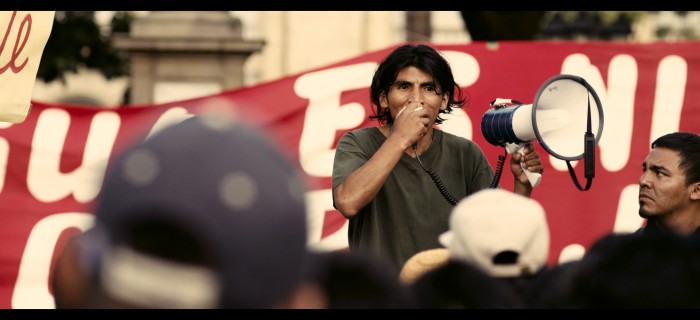
From their first day in Bolivia it is clear that this will not be an easy project. At the casting, hundreds of local people, many of whom have walked for hours to get there, are lined up. They have been promised a chance to audition, and no one is leaving without being seen. A fiery young indigenous man, Daniel (Juan Carlos Aduviri), immediately stands out and is cast as the Taino rebel “Hatuey.” To Costa and Sebastián’s dismay, however, the same charisma that makes Daniel a good leading man also makes him a good political organizer. As they soon discover, Daniel is a key leader in his people’s struggle against the privatization of Cochabamba’s water supply—the now famous “water wars.” His activism puts his life at risk and, more importantly for the filmmakers, jeopardizes the completion of the film.
The cinematography in Even the Rain is epic, with lush shots of the Bolivian Amazon—posing, in Sebastián’s film, as Caribbean jungle. Scenes of Spaniards and Indians moving through the immense foliage are reminiscent of Werner Herzog’s Aguirre: the Wrath of God, which had the volatile German actor Klaus Kinski traipsing through the Peruvian rainforest as a conquistador in search of El Dorado. As legend has it, the filming of Aguirre was incredibly difficult, with the cast and crew exposed to many dangers, and Kinski terrorizing the indigenous Peruvians working as extras and stagehands.
Even the Rain gives you an idea of what may have happened after Herzog yelled, “Cut!” Local reality interferes with the making of the film, and relationships between the Spanish cast and their indigenous counterparts are fraught with racial tensions.
But director Sebastián (like all of García Bernals characters) is likable and pensive. He is haunted by the words of the Dominican friar Antonio de Montesinos, who delivered one of the first condemnations of Spanish oppression of indigenous people. In a famous sermon, Montesinos declared, “I am a voice crying in the wilderness… Are these Indians not men? Do they not have rational souls? Are you not obliged to love them as you love yourselves?”
Stay in the loop with Food First!
Get our independent analysis, research, and other publications you care about to your inbox for free!
Sign up today! Sebastián is tormented by an intense contradiction: on the one hand, his commitment to a cinematic vision of indigenous agency and human rights and, on the other hand, his frustration with these contemporary Indians, whose perplexing intransigence makes his work so difficult. As I watched, I couldn’t help but think that this movie poses some important questions for NGOs, researchers and activists who, despite a deep commitment to “empowerment,” are often impatient with local politics. For people and organizations working for social justice, Even the Rain invites us to pose some difficult questions: Do our “projects” and careers actually separate us from the people we claim to serve? What kind of personal and organizational transformation is necessary in order to create genuine solidarity?
Nonetheless, the film is not didactic or moralizing. Nor does it seek to school us on the evils of neoliberalism. Perhaps the most politically heavy-handed (though not unrealistic) scene has the film crew clinking champagne glasses with the mayor, while crowds of protesters are tear-gassed outside. But overall, Even the Rain foregoes ideology to focus on relationships between people, and the barriers (class, race, gender) that divide us.
--> // // Removidas / comentadas de forma segura. Se precisarem no futuro, reimplementar sem misturar HTML comment com PHP. ?>
 Help Food First to continue growing an informed, transformative, and flourishing food movement.