What Place for Urban Farmers in the International Year of Family Farming?
The UN declared 2014 as the “International Year of Family Farming” (IYFF) in recognition of the importance of family farms in tackling hunger and poverty, empowering women, protecting biodiversity and enhancing food security. While the IYFF places a strong focus on family farming in rural areas, what about family farming in urban areas?
Fifteen to twenty percent of the world’s food is produced through urban farming, involving an estimated 800 million people.
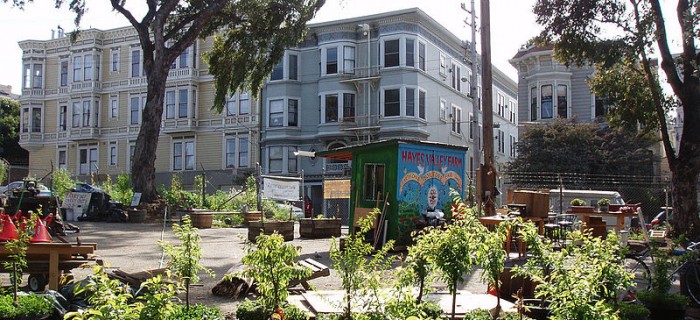
Urban farming is more than rooftop gardens and planting a few tomatoes in the backyard. In fact, 15 to 20 percent of the world’s food is produced through urban farming, involving an estimated 800 million people.1 Producing food in cities significantly reduces energy and resources needed for packaging, storage and transportation, and can recycle sewage and organic waste.2 Like rural family farming, urban farming generates important benefits including opportunities for employment, community building, access to healthy food and local control over resources.3 Urban farming attempts to repair the link between production and consumption that has been eroded by the current industrial food system. Reclaiming control of food production is not only crucial for farmers and peasants, but also for urban dwellers who often have little choice regarding the food that is available or affordable.

Figure 1. The Extent of Urban Agriculture (constructed by the author)
Countless organizations—such as City Slicker Farms in Oakland or Growing Power in Milwaukee— have been growing food in vacant city lots as a way of asserting the right to healthy food, the right to the city, and the right to freedom of choice; unalienable rights that have been violated by the industrial model of food production. These movements also challenge the racism and classism embedded in the current food system.
Ron Finley, an urban gardener from South Central Los Angeles, describes gardening in his TED talk as the “most therapeutic and defiant act you can do.”4 Finley planted food in the parkway outside his home in a neighborhood colonized by fast food restaurants, liquor stores and vacant lots. The USDA’s Economic Research Service estimates that 23.5 million Americans live in so-called food deserts like South Central LA.5 Finley, like many other activists and urban gardeners, fought the laws that ordered him to either clear his garden or purchase an expensive permit. He planted a garden than fed “both stomachs and souls” of those in the area, while serving as a symbol of defiance against the corporate food system.6
Nevertheless, urban farming, like family farming, faces numerous internal and external threats that prevent it from achieving its full potential to create jobs, feed people, protect the environment, and promote local control of productive resources. For instance, barriers to accessing land and skyrocketing land values often lead to gentrification and exclusion of individuals and communities who would most benefit from urban farming.7
Without political change, certain models of urban farming can actually reinforce—or even deepen—existing inequities. The Hantz Farms, the “world’s largest urban farm” located in the city of Detroit, is an example of this phenomenon. The economic crisis left Detroit plagued with vacant lots and more than $18 billion in debt.8 The city owns about one third of the real estate through foreclosure.9 The Hantz Group’s goal is to buy vacant properties from the city to create urban farms, which they argue, “converts blight to beauty, creates jobs, and strengthens the city’s budget.”10 John Hantz, the financial-services entrepreneur and owner of Hantz Farms, proposed converting 10,000 acres of vacant private and city-owned land.11 However, this enormous land investment creates land scarcity that raises land values and generates wealth and power for the Hantz Group while undermining low-income residents and community members. Furthermore, there is very little value generated from the farms themselves since only 10 percent of what is grown is actually produce.12 Urban farming practiced in this manner leads to the commodification of land and becomes a profit-making tool instead of a tool for promoting equity and justice in the food system. The Hantz Group suggests that it is the only solution in a hopeless Detroit, thus making invisible the work of numerous groups, like the Detroit Black Community Food Security Network, which are practicing urban agriculture with and for the community.
Stay in the loop with Food First!
Get our independent analysis, research, and other publications you care about to your inbox for free!
Sign up today!As the International Year of Family Farming progresses, it is important to make visible the true face of family faming, including the burgeoning movement to grow food for communities on urban land.
As the IYFF progresses, it is important to make visible the true face of family faming, including the burgeoning movement to grow food for communities on urban land. It is also important to look at urban farming projects and ask, who controls the land and decisions? Who reaps the most benefits? While both family farming and urban farming are widely hailed as solutions to our multiple global crises (food, finance, energy, climate), the question remains: can urban agriculture be used as a tool to put control of food production back in the hands of families and communities? Will it be adopted as a relief program to improve the conditions of communities without tackling the root causes of the food crisis? Or will it become a market-based, “green-washing” technique that reproduces inequality and injustice in the food system?
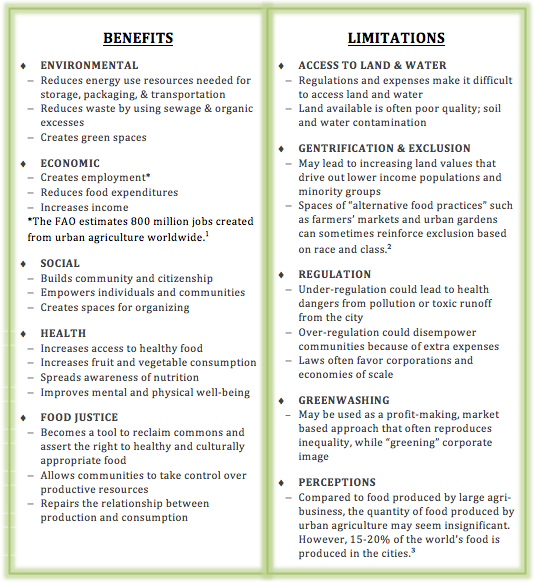
Figure 2. Urban agriculture: Benefits and Limitations (constructed by the author)
Notes:
1. Henk de Zeeuw, “The Development of Urban Agriculture; Some Lessons Learnt,” English (presented at the International Conference “Urban Agriculture, Agro-tourism and City Region Development,” Beijing: Resource Centres on Urban Agriculture and Food Security (RUAF), 2004) http://www.ruaf.org/sites/default/files/development_ua_lessons.pdf
2. Gayathri Devi Mekala, Stephanie Buechler, and Ben Keraita, “Wastewater Use for Urban and Peri-Urban Agriculture,” in Cities Farming for the Future (RUAF) http://www.ruaf.org/sites/default/files/Chapter%209.pdf; Jac Smit, Joe Nasr, and Annu Ratta, “Cities That Feed Themselves,” in Urban Agriculture: Food, Jobs, and Sustainable Cities, 2001 Edition (The Urban Agriculture Network, Inc.) http://jacsmit.com/book/Chap01.pdf
3. Golden, Urban Agriculture Impacts: Social Health, and Economic: A Literature Review, Literature Review (University of California: Agriculture and Natural Resources, November 13, 2013), http://asi.ucdavis.edu/sarep/sfs/UA%20Lit%20Review-%20Golden%20Reduced%2011-15.pdf
4. A Guerilla Gardener in South Central LA http://www.ted.com/talks/ron_finley_a_guerilla_gardener_in_south_central_la
5. “Food Deserts,” United States Department of Agriculture: Agricultural Marketing Service, http://apps.ams.usda.gov/fooddeserts/foodDeserts.aspx
6. Steve Lopez, “In the Weeds of Bureaucratic Insanity There Sprouts a Small Reprieve,” Los Angeles Times, August 20, 2011, http://articles.latimes.com/2011/aug/20/local/la-me-0821-lopez-garden-20110818
7. Chiara Tornaghi, “Critical Geography of Urban Agriculture,” Progress in Human Geography 38, no. 1 (February 5, 2014)
8. Monica Davey, “Billions in Debt, Detroit Faces Millions in Bills for Bankruptcy,” The New York Times, October 7, 2013, sec. U.S., http://www.nytimes.com/2013/10/08/us/billions-in-debt-detroit-faces-millions-in-bills-for-bankruptcy.html
9. Hantz Farms: Detroit’s Saving Grace, 2012, http://www.youtube.com/watch?v=5B36rrj1zc0&feature=youtube_gdata_player
10. Ibid.
11. Matthew Dolan, “New Detroit Farm Plan Taking Root,” Wall Street Journal, July 6, 2012, sec. US, http://online.wsj.com/news/articles/SB10001424052702304898704577479090390757800?mg=reno64-wsj&url=http%3A%2F%2Fonline.wsj.com%2Farticle%2FSB10001424052702304898704577479090390757800.html
12. Hannah Wallace, “Malik Yakini of Detroit’s Black Community Food Security Network,” Civil Eats, Dec. 18, 2011, http://civileats.com/2011/12/19/tft-interview-malik-yakini-of-detroits-black-community-food-security-network/
Figure 1: The Extent of Urban Agriculture
1. Orsini, Francesco, Remi Kahane, Remi Nono-Womdim, and Giorgio Gianquinto. “Urban Agriculture in the Developing World: A Review.” Agronomy for Sustainable Development 33, no. 4 (March 4, 2013): 695–720.
2. Orsini et al. “Urban Agriculture in the Developing World: A Review.” Op. Cit.
3. Henk de Zeeuw, “The Development of Urban Agriculture; Some Lessons Learnt,” English (presented at the International Conference “Urban Agriculture, Agro-tourism and City Region Development,” Beijing: Resource Centres on Urban Agriculture and Food Security (RUAF), 2004. http://www.ruaf.org/sites/default/files/Working%20paper%203%20%20Cities%20Food%20and%20Agriculture.pdf
4. Koont, Sinana. “A Cuban Success Story: Urban Agriculture” 40, no. 3 (June 20, 2009): 285–91.
Figure 2: Benefits and Limitations of Urban Agriculture
1. Urban and Peri-Urban Agriculture, Handbook Series (Rome: Food and Agriculture Organization of the United Nations: The Special Programme for Food Security, July 2001), http://www.fao.org/fileadmin/templates/FCIT/PDF/briefing_guide.pdf
2. Julie Guthman, “‘If They Only Knew’: Color Blindness and Universalism in California Alternative Food Institutions,” The Professional Geographer 60, no. 3 (2008): 387–97.
3. Henk de Zeeuw, “The Development of Urban Agriculture; Some Lessons Learnt,” English (presented at the International Conference “Urban Agriculture, Agro-tourism and City Region Development,” Beijing: Resource Centres on Urban Agriculture and Food Security (RUAF), 2004), http://www.ruaf.org/sites/default/files/development_ua_lessons.pdf
--> // // Removidas / comentadas de forma segura. Se precisarem no futuro, reimplementar sem misturar HTML comment com PHP. ?>
 Help Food First to continue growing an informed, transformative, and flourishing food movement.