
Walking the Alternative Vision in South Korea
Is there an alternative vision to South Korea, beyond the hyper-capitalism, the rapid development, the big infrastructure, the fast lifestyle, and the globalized markets? And can you see it if you look in the right places?
Like a sprout pushing out of a seed and into the sunshine, there is an emerging alternative to this increasingly fast-paced lifestyle, gathering strength in South Korea—if you know where to find it. It is a movement that appeals to older people clinging to tradition, and young people at the beginning of their careers. It is an effort to value and preserve a sense of “Koreanness”—Korean life, its natural places, its indigenous foods, its arts and culture, the chance of a rural lifestyle.
Promoting safe and healthy food and sustainable agricultural development is a part of this trend. It is an established movement but it is enjoying new growth, spurred on by a trend toward preservation of sovereignty and against globalism.
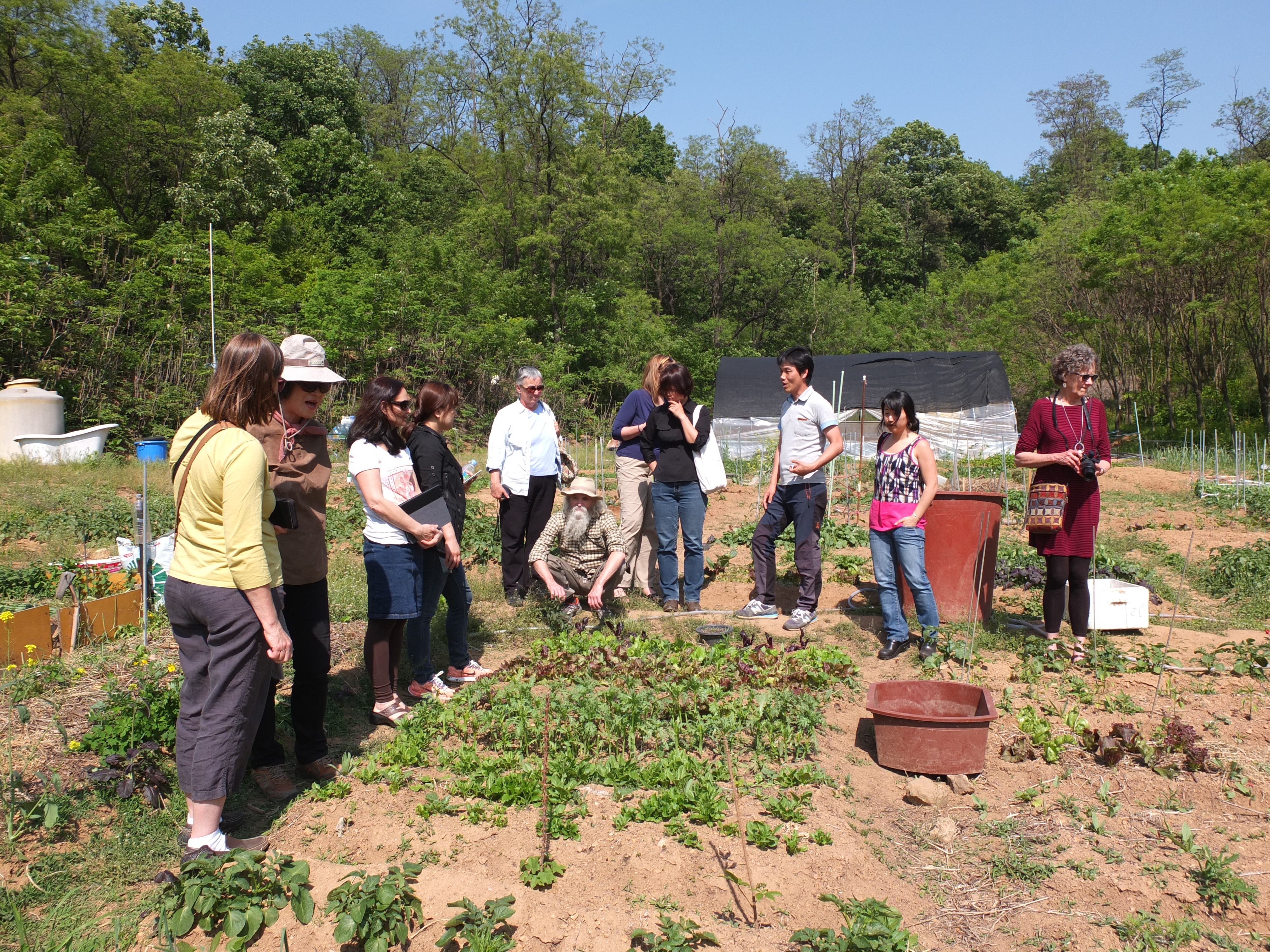 One can see food sustainability in action and other lifestyle innovations through a nine-day guided tour offered by the food policy organization Food First. Its Food Sovereignty Tours are offered in a wide variety of countries. Coming up in 2015 and 2016 are tours to Hawaii, Basque Country (Spain), Chiapas (Mexico), Cuba, Oaxaca (Mexico) and Piedmont (Italy). The Land, Food, and Democracy Tour in South Korea was held first in 2013, and for the second time in May 2015.
For Koreans, growing their own food is synonymous with independence and self-development. Korea accepted food aid from the U.S. for many years in the post-war era, which also fueled Korea’s industrialization and changed the food system forever, according to [tour coordinator and Food First] food policy researcher Anders Riel Muller. Starting in the 1980s, trade policies were liberalized in South Korea, causing a weakening of food sovereignty, that is, the ability of the country to feed itself.
The sustainable agriculture movement is also riding the trend of “well being,” picking up new consumers who want better health and safer food, but who may not be informed about or share the longer-term values of preserving the nation’s economic and ecological future.
There are some huge organic agriculture cooperative organizations in South Korea—such as Hansalim with 500,000 consumer-members—that provide food for an estimated 1.6 million people in South Korea. There are also some small ones, such as an urban farming cooperative that emphasizes alternative lifestyle awareness and raises food crops in nylon bags and plastic boxes on the flat rooftops of several high-rise buildings in Seoul.
Stay in the loop with Food First!
Get our independent analysis, research, and other publications you care about to your inbox for free!
Sign up today!Food safety scares involving imported foods have persuaded many Koreans that Korean food is the safer alternative. The nuclear power plant meltdown at Fukushima in nearby Japan got South Koreans concerned about the quality of imported food as well. Persistent demonstrations by farmers and other small procedures in advance of the Korean–U.S. Free Trade Agreement negotiations (the trade deal known as KORUS–FTA, approved in 2012) showed a widespread understanding how opening up Korea to global markets would be hard on small producers and small farmers, as it pushes down average prices for many products and removes trade barriers for large multi-national corporations.
Korean small farmers, who have always been a well-organized force of the nation’s economy and its conscience, have had a more urgent task since the KORUS–FTA: to Save Korean-grown food and save the livelihoods of rural farmers. They have developed alternative economic models, through various organizations, of how to avoid the global marketplace completely, and do business directly with their consumers, delivering the fresh, safe food they want at a reasonable price. There has been some urgency to push those models, because the pressure on independent Korean farmers is increasing, and many farmers welcome an alternative to being subject to risky global markets.
The Food Sovereignty Tour to South Korea brings participants to see for themselves, ask questions (with translators), and listen to the leaders of these organizations discuss what works and what does not work in South Korea.
Food First bills itself as a “people’s think tank” which is “dedicated to ending the injustices that cause hunger and helping communities to take back control of their food systems.” Working with researchers in many countries, Food First promotes citizen engagement with institutions and policies that control food, and aid in the integration of local, national, and global efforts. They work to amplify the voices of social movements fighting for food justice and food sovereignty.
The Land, Food, and Democracy tour participants in 2015 were all Americans, and all activists in their own right. They included a deputy mayor of a city, who was also a soil scientist and sustainability consultant, a professor of forestry, a woman who works at an Alaska land trust, a couple who teaches self-sufficient and sustainable living, a retired labor activist, and an urban activist working in a statewide farmers advocacy organization in Kentucky. The group also included two Korean Quarterly staff, the only tour participants who had previously been to Korea.
The tour started in Incheon and ended in Seoul, taking a route that went east, south, west, and north in a circle that visited the farmland of several regions in central South Korea.
It included some urban agricultural networks, such as the Incheon Urban Agriculture Network, which has multiple purposes for its organic agricultural farming activities, including teaching farming in an urban area to school children, single mothers, and other groups through community activities. The organization gets funding from $60 annual memberships and donations, but does not have government support. It borrows vacant land not being used for other purposes—a precarious system at best.
E levated Gardens and Aware Citizens
Another urban gardening model is the rooftop garden system organized by the Women’s Environmental Network in the Hongdae area of Seoul. The group maintains a publicly accessible garden on the rooftop of the building where its office is located, and two other rooftops in the area. Similar to the Incheon group, the Tari (“bridge”) Community Gardens exist because of informal agreements with landowners. Plants, even fruit trees, are grown in nylon bags and plastic boxes so that the whole garden can be evacuated and repositioned on a new rooftop if necessary.
Director Bo-eun Lee observed that the rooftop garden members are residents who want space for old and young to interact; parents who want their children to participate in gardening as a healthy activity; or people who want a break form the demands of city life and are interested in returning to more traditional activities such as hand crafts, cooking and farming. The program also includes activities to sell garden products to an organic café and through a garden market. Members can also attend an annual farmers’ school. Lee said she has seen some of her members leave the organization because they want to try farming for a living. Two members have recently decamped for rural areas, she said.
The Women’s Environmental Cooperative Network also increases awareness of the importance of farmer–to–consumer transactions with Marche, an occasional pop-up style market that brings consumers in contact with invited farmers. Marche, which relocates in a different public park each time it convenes, teachers sustainable practices, holds dialogues about subjects like seed-saving and native foods, sells hand crafts, and teaches cooking classes using the produce that is sold, Lee said.
A recent incarnation of Marche hosted about 50 farmers, 30 chefs, and 20 artists, and resulted in about 200 sellers doing commerce with about 3,000 to 4,000 customers. However, Marche as a community organization is not simply about commerce. A large part of it is about educating people to be “aware citizens,” Lee said.
Yangpyeong: Public/Private Partnership
The tour next went to Yangpyeong, an area to the east of Seoul, which provides much of the city’s water through a dam on the river. It is sparsely populated with a high percentage of arable land. Because of its position as the water source for a city, environmentally friendly agriculture is conducted. Yangpyeong is a rare example of a government-run agricultural cooperative (the Yangpyeong Regional Public Corporation). The region was certified as a special zone for environmentally friendly practices in 2005, which made it a target for government funding.
Its director said that the area used to be poor, however, the average standard of living is now increasing as farmers receive better support for farming. About 20 percent of the farms in the area are now certified organic, he said. There are still no rich farmers—many have two or three jobs to make ends meet, he added.
 The area farmers are learning together how to strengthen their business practices as a cooperative. In 2013, 2,600 farmers attended a forum on direct sales and local production and consumption. With Ministry of Agriculture funding, they established a new direct sales store last year, through which 50 percent of the sales price of the products goes directly to the grower—20 percent higher than what a farmer would get with a mainstream intermediary distributor. They are encouraging memberships in the direct-buy store, and will diversify the crops to be sold at the store in the future. Their projections through 2018 include an estimated 25,000 consumers with 500 farmers supplying the local stores.
Yangpyeong cooperative also supplies a store in the rich Gangnam neighborhood of Seoul, where consumers are happy to pay more for Yangpyeong products. Interestingly, Yangpyeong also has a tourist trade of people visiting its mountainous forested area for “healing” kinds of vacations, the director said.
On a farm visit, Mansoh Shin explained how he and his wife raise several kinds of vegetables in a farm of one hectare, consisting of several giant hoop houses. He sells 20 percent of his crops to the local store and 60 percent to a school lunch program. The farm requires he and his wife to work about eight hours a day in the off-season and as much as 15 hours a day in the summertime.
Hansalim: Large, Diverse, and on a Mission
The tour also visited Hansalim, a giant agricultural cooperative headquartered in Goesan, North Chungchong Province. Tour participants met for a briefing in its original, traditional-style meeting house. The simplicity of the surroundings belies the complexitiy of the organization and the challneges it has taken on.
Later in the day, the group toured a typical organic crop farm, a traditional seed-saving operation, a beef operation, meat packing and organic animal feed plant, as well as a Hansalim store.
All producers and distributors of Hansalim are members, exclusively doing business with the cooperative. This involves not just growing food, but invites a particular belief system—that food is connected to life in a web that takes in farmers, producers, and consumers, and that all have a duty to live responsibly and preserve the earth. Likewise, Hansalim customers need to be consumer-members first; no non-members can buy its foods, not even from a store.
Hansalim farmers are protected by the organization financially and supported socially. For example, if a crop fails, the farmer can be compensated from a “price stabilization fund,” Hansalim spokesman Ji Young Moon explained.
This responsibility goes beyond farming and extends to a social movement to build community and take part in policy-making, particularly in the areas of sustainability and food safety. The belief system is the source form which the Hansalim cooperative emerged back in 1986, the heyday of the pro-democracy movement in South Korea.
Han means “one,” “whole,” or “the earth,” while salim refers to domestic activities that must be managed to care for one’s home, family, children, and community, as well as to revive and give life. It is a term that is both grandiose and humble at the same time. On its English-language website, Hansalim translates its name as “meaningful daily action to save life and earth.”
Hansalim is feeding a lot of people. Its consumer members exceeded 500,000 in March 2015. It is also employing a lot of people in distribution centers, stores, and processing facilities for meat and for value-added products made with its produce, such as kimchi, noodles, jams, and frozen foods. In September 2014, Hansalim was conferred the first-place achievement award, the One World Award, by the International Federation of Organic Agriculture (IFOAM).
Hongseong Youth Collective Farm
In south Chungchong province, the tour group met farmer Min Chul Jung at his farm, the Hongseong Youth Collective Farm, which he established with two of his former agriculture students. Jung is a former teacher of agriculture at the nearby Poolmoo Schoool, a farming town, school, and agricultural and sustainability think-tank in Hangseong.
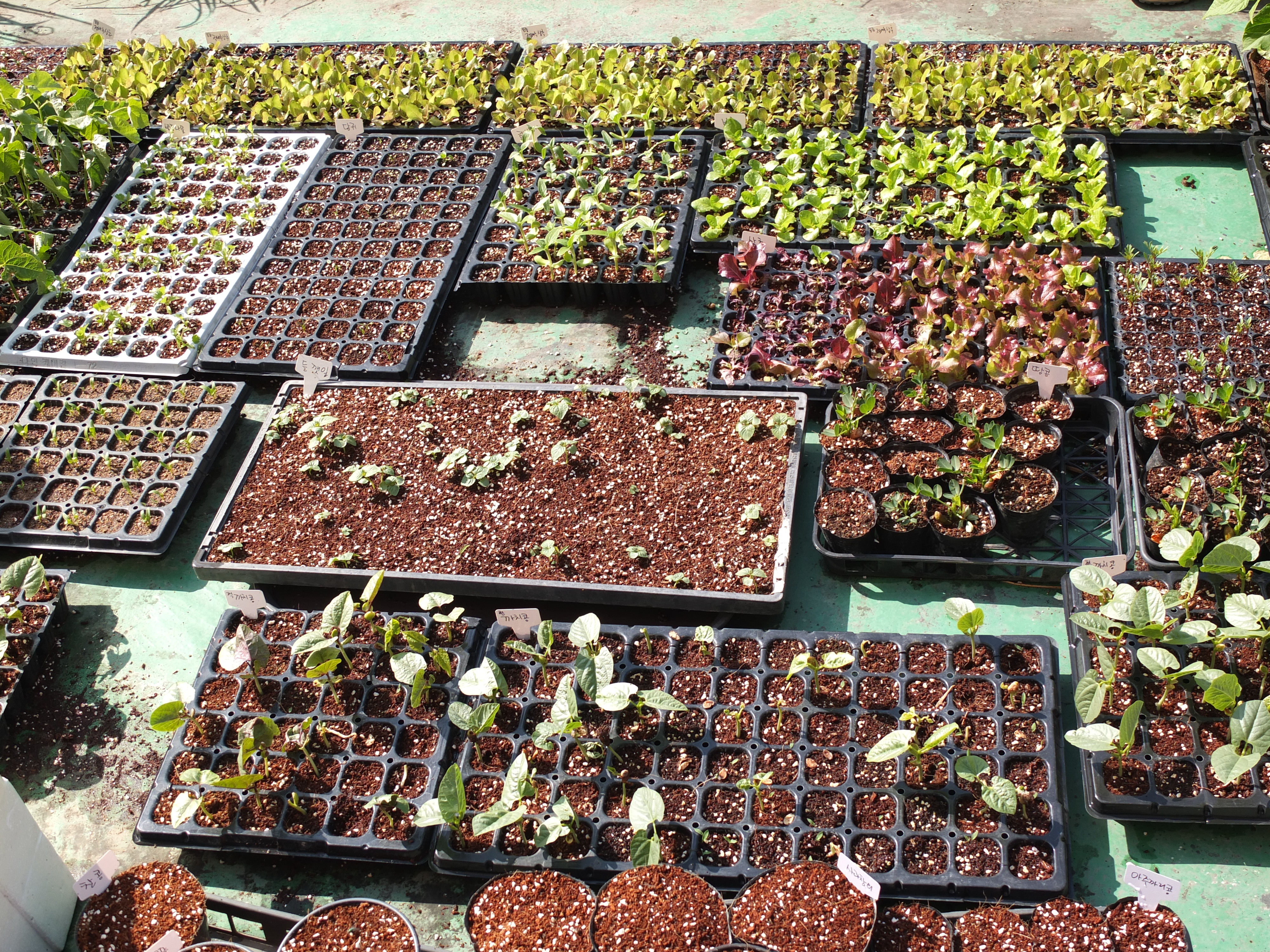 Jung said he started the farm with some cooperative pattern investors and two students who had graduated from the school, but could not afford to get into farming by themselves. The concept was to lower the many financial barriers to farming for graduates who wanted to give it a try. His farm serves as a kind of internship location for Poolmoo agricultural school graduates, where they get on-the-ground experience of the hard work and joy of being a farmer.
Although he has never promoted the farm, Jung said he has many people from urban areas make inquiries about working there and trying out the farming lifestyle. In all, about 30 former students of Poolmoo School have worked there, he said. There are now 42 member-investors in the farm, and seven are working members.
Jung said most young farmers do not have enough money to invest and buy land, and that it is unusual for land to even come up for sale. City dwellers would prefer to hang onto their family land no matter what, on principle. Land ownership tends to be locked up, and many farmers simply lease their farmland.
The Hangseong Youth Collective Farm has spun off other collective farms in the immediate area, each with its own social mission. A nearby farm is focused on helping with the treatment of people with psychological issues, Jung said.
Poolmoo Cooperative: Teaching Farming for the Future
At the nearby Poolmoo Organic Cooperative, Soon-Myung Hong, an 80-year-old senior teacher who has spent most of his adult life there, gave the group a short introduction into the history of the 56-year-old school. The Poolmoo Cooperative is surrounded by other cooperative farms—the former students have been key in increasing the quantity of organic and cooperatively farmed land in the region, he said. The headquarters of Poolmoo includes buildings for classrooms and meeting rooms, school dormitories, a library, bakery, cooperative store, fields and hoop houses that are maintained by students, livestock, barns and other farm-related buildings. It is very much like a town, but focused on the teaching of farming.
The geographical area around Poolmoo, with its 67 percent arable land, is an asset. Similarly, the Pool Moo School, which educates students from kindergarten through college, is an asset to the farming community of the area. Back when the school was founded, the founders were attempting to address the lack of education in rural areas, Hong said. Children rarely went to college or even high school. Poolmoo was established, as a Christian school, in part, to treat this pressing societal problem. Teaching organic agriculture started later, in 1976.
Poolmoo, the business part, does its own production, processing, storage and distribution of products, as organized by the various cooperatives. Consumers of their products may pay up to 30 percent higher than for mainstream products, yet demand for its high-quality produce is increasing, Hong said.
Poolmoo, as a place of ideas, is always changing with the times, and the situation of locked-up agricultural land ownership, mentioned by Jung, is one of those issues they have been working on. “This year, we have made a fund for a land trust,” Hong said. The plan is to establish a fund that will help farmers to either get land free, or at a low-interest rate.
 Outside of the Poolmoo library, a bulletin board flaps with multiple postings on upcoming classes or lectures invented and led by teachers, students, and alumni, that included a non-violence lecture and study group, a seed library lecture, a talk on a soon-to-be-established children’s library, a class to read the (Korean) Constitution, a classics study group, a group on writing a personal history, and instruction on how to build a log house.
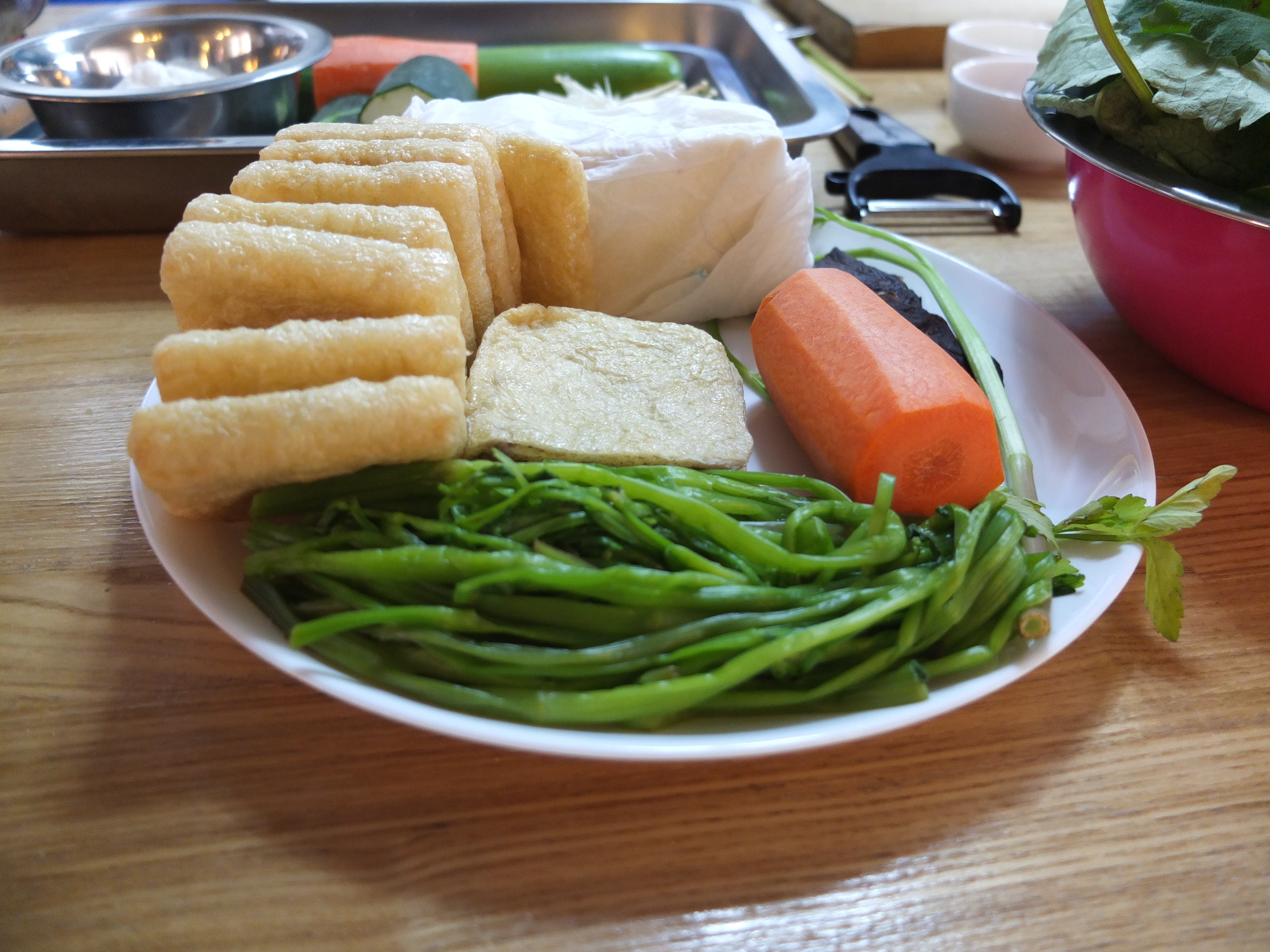
Back in Seoul, the tour included a cooking lesson and lunch featuring vegan Buddhist cuisine in the cooking studio HoyaCooks, owned by chef Hoya Lee, translator and logistics manager of the tour. The last evening was a fun night walk to discover some of the hot late-night cafes and snack shops in the Hongdae area led by tour operator Daniel Gray.
Originally published in Korean Quarterly, Summer 2015, vol. 18, num. 4.
Korean Quarterly – Walking the Alternative Vision
Subscribe to Movements, a newsletter of Food Sovereignty Tours, to learn about upcoming delegations to South Korea.
--> // // Removidas / comentadas de forma segura. Se precisarem no futuro, reimplementar sem misturar HTML comment com PHP. ?> Help Food First to continue growing an informed, transformative, and flourishing food movement.